Meal Planning for Couples: One Weekly System That Works
· CookBuddy
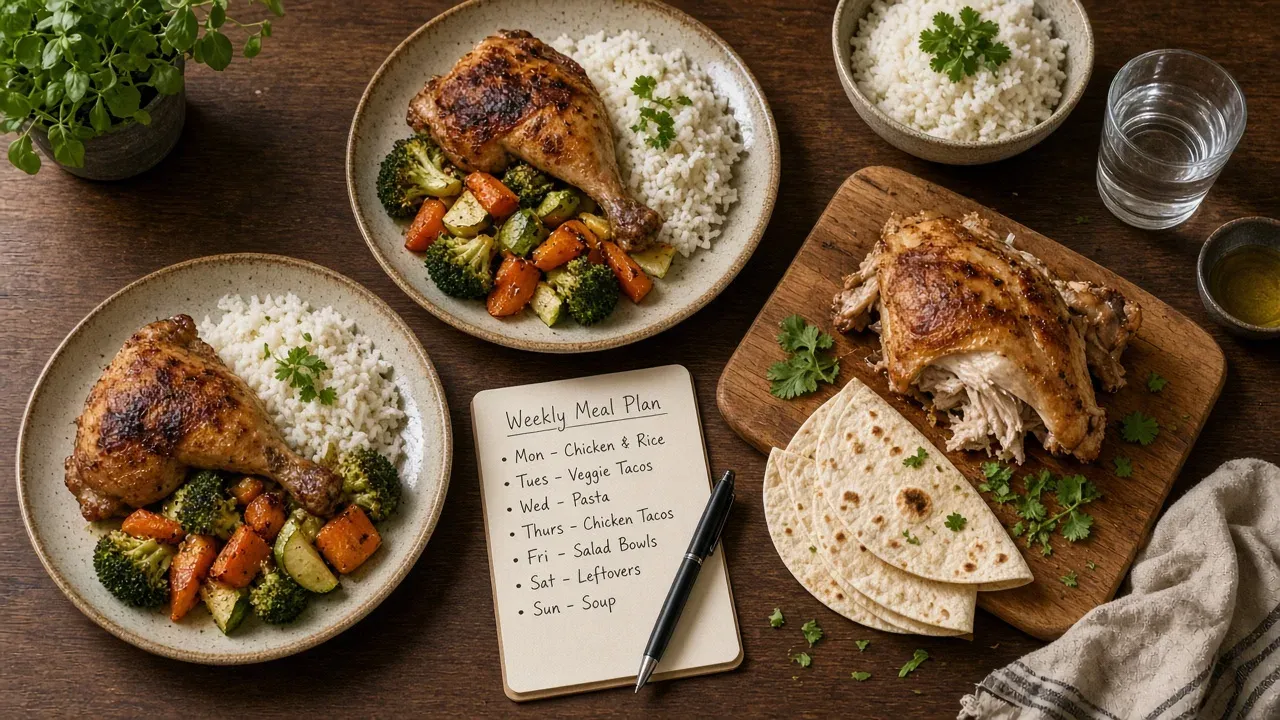
Meal planning for couples works best as one repeatable weekly system, not a new plan every Sunday: pick a flexible framework that flexes across tight budgets, mismatched schedules, and different diets, cook in portions sized for two, and chain leftovers so every half-used ingredient gets a second meal. This guide gives you that framework, the scaling rules, and the repurposing loop.
Key takeaways
- Plan four or five dinners per week instead of seven, with a built-in flex night so the plan survives real life.
- Chain ingredients across meals, like one roast chicken becoming tacos, so nothing half-used gets thrown away.
- Couples with different diets should cook one shared base and split it at the final step, not make two dinners.
- Alternate the planning week between partners so the invisible work of deciding what's for dinner is shared.
- Refresh the plan monthly by swapping two or three recipes rather than rebuilding the whole week.
How do you meal plan for just two people without wasting food?
Most meal plans are built for families of four or five. Scale them down to two and you either cook the same dinner three nights running or toss half a bunch of cilantro every week. The fix is a smaller plan with smarter structure, not more planning. For a 14-day leftover calendar built the same way, see meal plan for two weeks on a budget.
The 4-5 dinner rule for couples
Pick four or five dinners for the week, not seven. You will eat leftovers one night, and something will come up. Five planned dinners with a built-in flex night beats a full seven-day grid that collapses by Wednesday. Portions tagged for two live in 15 easy weeknight dinners tagged by time if you want a starting rotation instead of a blank calendar. If one grocery run is supposed to cover those five dinners, easy weeknight Trader Joe's meals assigns each meal a night based on how it ages.
Plan ingredient chains, not just meals
The single biggest waste driver for two-person households is buying a whole ingredient for one recipe. Plan chains instead: roast a whole chicken Monday for tacos Wednesday; cook a full pot of rice that becomes fried rice Thursday. A head of cauliflower goes into a stir-fry, then a curry. This is where a searchable recipe box earns its keep. If every saved video and screenshot turns into a written recipe you can filter, building chains takes minutes instead of an evening with a notes app. CookBuddy converts cooking videos from TikTok, YouTube, and Instagram into written recipes in under 3 seconds. The faster you can retrieve a recipe, the more likely you actually cook it before the ingredients turn.
Where screenshots and saved posts break down
A camera roll of screenshots has no ingredient view, no search, and no memory of what you cooked last month. Store cooked leftovers within two hours and use them within three to four days, per the USDA's leftover guidance and FoodKeeper storage times. That window is exactly why chains work: repurpose by day three, or freeze. Pull those screenshots into written recipes with save recipes from social media.
What is the cheapest way for a couple to meal plan each week?
The cheapest approach for two is building weeks around a few cheap staples, buying proteins in family packs, and splitting them into two-meal portions before freezing. Most budget advice targets families of four, so the real trick for couples is portioning: a single family pack becomes four weeknight dinners, not four nights of the same leftovers. If you do cook for four, the cheap dinner ideas for family rotation uses the same leftover-chicken logic at household scale.
Family-pack proteins, couple-sized portions
Buy chicken thighs, ground beef, or pork shoulder in the large pack, then divide it into two-person portions the day you shop. Freeze what you won't cook within three days and label it. This cuts your per-pound cost without forcing you to eat the same dinner twice in a row.
A sample $60-ish week (illustrative)
Anchor the week on rice, beans, eggs, pasta, and one or two in-season vegetables, then add two proteins from family packs. A rough split: $20 protein, $15 produce, $10 dairy and eggs, $15 pantry staples. Prices vary by store and region, so treat this as illustrative rather than exact.
The other half of saving money is not re-buying recipes you already found. If your saved TikToks and screenshots live in your camera roll, you plan from memory and default to takeout. Convert them once, then plan from the box: how to save recipes from TikTok covers the capture step so cheap staples actually get used.
How can working couples with different schedules still eat dinner together?
Most dual-income couples don't need to eat at the same time every night. They need a small set of reliable shared meals plus a plan for the nights they can't. The American Time Use Survey shows Americans spend a large share of evenings on work and commuting, so build the plan around that reality instead of wishing it away.
Anchor nights vs float nights
Pick two or three anchor nights a week when you both commit to eating together, and treat everything else as float nights: whoever's home eats, whenever they're home. Anchor nights get the recipes worth sitting down for. Float nights get leftovers or a 10-minute assembly meal. Write the anchors on the shared grocery list so neither of you is guessing. Fast assembly options sit in easy quick delicious dinner recipes.
Make-ahead bases for whoever gets home first
Whoever lands first starts a base: rice, beans, a braise, roasted veg. The late arrival finishes theirs on top. Save those base recipes from cooking videos into a written recipe you can open on your phone, and sort them with dietary filters if your schedules come with different diets. CookBuddy does the conversion in under 3 seconds on iOS and Android. It does not plan the week or build a grocery list; see what's included at CookBuddy pricing. For a two-hour Sunday cook that fills those bases, use easy weekly meal prep ideas.
What do you do when one partner is vegetarian, allergic, or dieting and the other isn't?
You don't cook two dinners. You cook one base and split it at the last step, which is the only way mixed-diet meal planning for couples survives contact with real weeknights. The same fork-in-the-road logic shows up in mixed-diet households in the family meal planning app guide.
The shared-base method
Pick dinners with a natural fork in the road: grain bowls, tacos, pasta, stir-fry. Cook the base — rice, beans, roasted veg, sauce — once, then divide. Meat goes in one half, plant protein or extra veg in the other. Two meals, one pan pile, ten extra minutes max. Keep both versions in your recipe box so either of you can rebuild last month's winners. CookBuddy has 50+ dietary filters for that split; it does not yet have shared cookbooks, so many couples share one login or keep the week's plan in a spreadsheet. For filing the two variants, see how to organize recipes. A five-meal vegetarian component matrix that uses the same grain-bean-veg-sauce base is in meal prep vegetarian ideas.
Handling allergies vs preferences
Allergies get the stricter rule: the whole base is allergen-free, and the allergy-free partner adds their item at the table (parmesan, peanut sauce, whatever). That way cross-contact never happens and nobody cooks separately. Preferences are looser — diverge at the pan, not the plate. If one of you is dieting, scale their portion and add volume (greens, broth) instead of building a different dish.
How do you scale couple-sized recipes up for guests or down for lighter weeks?
Recipes that scale and recipes that don't
Braises, soups, stews, and chili scale almost linearly: double the ingredients, add 20-30% more time, and use a wider pot so the liquid level stays similar. Casseroles and braises are the safest bet for feeding four to six from a two-person recipe.
Baked goods and pan-cooked proteins don't cooperate. Baking is chemistry, and halving flour, eggs, and leaveners changes structure, not just volume. King Arthur's bakers recommend weighing ingredients instead of measuring by volume to make scaling predictable. Pan-cooked proteins scale by pan space, not time: two chicken breasts need the same cook time as one, but six in one pan will steam instead of brown.
Halving without wrecking seasoning and cookware
Halve everything except salt, spices, and chili heat, then taste and add to about 75% of the original amount. Keep the cook time, not the ingredient math: a halved roast still needs most of its original time, while halved cookies bake a minute or two less. Use smaller cookware so sauces reduce properly. If you save recipes from videos, store the original next to a short note with your scaled amounts. CookBuddy turns a saved TikTok into a written recipe you can keep; for how that capture step compares with another recipe keeper, see our Samsung Food app review.
Should couples use a meal planning app or a shared spreadsheet?
A shared spreadsheet wins on cost and total control; an app wins when recipes live in TikTok saves and screenshots. Run both through the same four criteria and the honest answer for most couples is: start free, upgrade only if a specific gap keeps biting you.
What a spreadsheet does well
A Google Sheet handles the weekly grid, the grocery list, and splitting who cooks what for exactly $0. Both partners can edit from their phones, and nothing gets lost when one of you forgets to update it. What it can't do: turn a saved cooking video into an actual written recipe. You're still copying ingredients by hand.
App options compared on the same criteria
| Tool | Shared access | Saves from social videos | Grocery list | Cost |
|---|---|---|---|---|
| Spreadsheet | Yes, both edit live | No, manual entry | Build it yourself | Free |
| Paprika Recipe Manager | One library via an account | Web clipping, not social video AI | Built in | One-time purchase |
| ReciMe | Shared cookbook | Video import | Built in | Free tier + paid |
| CookBuddy | No shared cookbooks yet | Video to recipe in under 3 seconds | No | Free (5 imports/month) or Premium |
CookBuddy Free includes 5 imports per month, unlimited storage, and 3 extra imports from ads. Premium is $3.99 per month or $35.99 per year for unlimited imports, on iOS and Android only. Paprika's one-time model is covered in our Paprika recipe manager review. ReciMe's paywall after five saved recipes is in the ReciMe app review. Mealime used to sit in the plan-first camp and shut down on October 21, 2026.
Where CookBuddy falls short for couples
CookBuddy is strongest at the saving step: paste a YouTube, TikTok, or Instagram link and get a written recipe, then filter by 50+ dietary needs, which helps when one of you is vegetarian. What it doesn't do yet is meal prep planning, grocery lists, or a shared cookbook two people can edit at once — gaps readers have asked about directly. If your week lives or dies on prepped lunches and a live list, a spreadsheet, Paprika, or ReciMe may fit better. Meal prep planning is a feature request, not a shipped feature.
How do you build a 7-day meal plan for two that you can repeat every month?
The repeatable 7-day template
Fill seven slots with fixed roles, not fixed recipes: two new-recipe nights, two leftover nights, one pantry night (frozen or pasta), one flexible night for takeout or whatever sounds good, and one fridge-clearing night that eats up half-used vegetables before your next shop. The roles stay the same every week; only the recipes inside them rotate. That structure is what kills the "what's for dinner" decision fatigue, because you're answering one question a week, not seven. A worked 7-day week of whole-food dinners at half-recipe scale is in clean eating meal plan for two.
The monthly refresh: swap, don't rebuild
Once a month, replace the two or three recipes you're sick of and keep the rest. Couples who keep a searchable recipe box make this painless, whether that's a long-lived Paprika library or a shared ReciMe account. CookBuddy works for the capture side: save videos from TikTok or Instagram as written recipes, filter by diet, and your monthly swap takes minutes. The free tier covers 5 imports per month; Premium is unlimited imports. For picking a primary filing system so those swaps stay findable, see recipe organization ideas.
How do you split the mental load of meal planning between two people?
The planning burden gets unequal because "what's for dinner" is invisible work. Someone decides, checks what's in the fridge, cross-references saved posts, and builds the grocery list. Pew Research finds that in many U.S. couples, one partner still does more of the cooking and shopping. The fix is making that work visible, shared, and scheduled.
Alternate the planning week, not just the cooking
Cooking and planning are different jobs. Trade the whole week: one partner owns dinners this week, the other owns next week. The planner picks the recipes, writes the grocery list, and answers "what's for dinner" all week. The other partner cooks, shops, or cleans per your usual split. Nobody carries the deciding forever.
One shared, searchable recipe box
Most couples' recipe collection lives in one person's camera roll. Move it somewhere both of you can search. Paprika Recipe Manager and ReciMe let you keep a library two people can use; CookBuddy converts social recipes into written form in seconds and keeps them organized with dietary filters, which helps when one of you avoids an ingredient. Be honest about limits: CookBuddy is mobile-only on iOS and Android, with no desktop cookbook, no grocery list, and no meal-prep scheduling. Shared cookbooks are on the roadmap, not in the app today.
Keep a simple decision log, too. A note of what you cooked each week kills the "we already had that" debate and makes next month's plan a copy-paste job. For the import-and-export matrix across six apps, see best digital recipe box in 2026. If a paid-once keeper is the real question, use the no-subscription recipe app guide.
FAQ
How much food should I buy for two people per week?
Plan four or five dinners for two, not seven, and shop for those plus breakfast and lunch staples. Buy family-pack proteins and split them into two-person portions the day you shop, freezing what you won't cook within three days. Anchor the rest on cheap staples like rice, beans, eggs, and pasta so half-used ingredients get a second meal instead of a trip to the bin. For a full grocery-and-leftover week built that way, see clean eating meal plan for two.
Is meal prepping for two worth it or does food go bad first?
Worth it, if you respect the storage window. Cooked leftovers kept in the fridge should be eaten within three to four days, per USDA FoodKeeper guidance. That means prepping for two works best when you chain leftovers into a second meal by day three, or freeze portions the day you cook. Prepping five days of identical lunches ahead usually ends with the last two in the trash. A two-hour Sunday cook that matches that window is in easy weekly meal prep ideas. Five distinct lunches from four protein bases, sized by weight for two different protein targets, is in high protein meal prep ideas.
What's a good meal planning app for couples that we can both use?
Look for three things: a shared cookbook both partners can edit, a built-in grocery list, and the ability to save recipes from videos or links instead of typing them by hand. Paprika and ReciMe cover sharing and lists. CookBuddy converts TikTok, YouTube, and Instagram videos into written recipes in under 3 seconds and filters by dietary needs, but it has no shared cookbook, grocery list, meal-prep scheduling, or desktop access. Match household size and shared lists in the family meal planning app guide.
How do I halve a recipe that serves 4 without messing it up?
Halve everything except salt, spices, and chili heat, then season to about 75% of the original amount and taste as you go. Keep most of the original cook time, since a halved roast still needs nearly as long. Use smaller cookware so sauces reduce properly. For baking, weigh ingredients instead of measuring by volume, because halved flour, eggs, and leaveners change structure, not just quantity.
How do working couples meal plan in India with long commutes?
Build the week around two or three anchor nights when you both commit to eating together, and let the rest be float nights where whoever's home eats whenever they arrive. Whoever gets home first starts a make-ahead base like rice, dal, or roasted vegetables, and the late arrival finishes theirs on top. Keep base recipes in a searchable place so either partner can start cooking. For AI-assisted capture of those bases, see AI meal planning.
meal-planningcouplesleftoverscookbuddyrecipes
CookBuddy turns cooking videos, webpages, and photos into written recipes you can keep in one cookbook.