Recipe Management App: How AI Changes the Way You Store Recipes
· CookBuddy
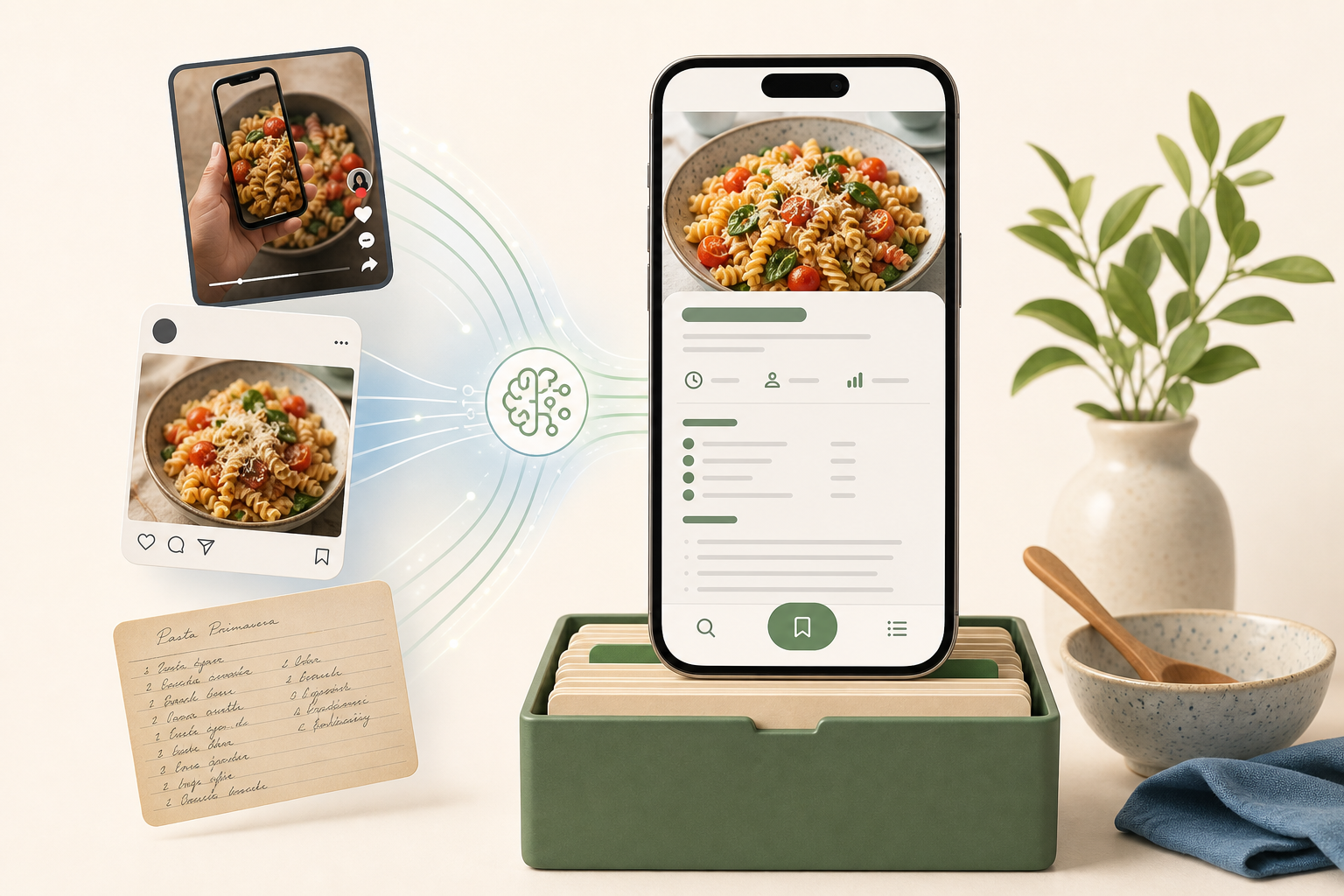
The way home cooks find recipes has changed completely. You scroll TikTok for ten minutes, save a pasta video, bookmark a YouTube channel, screenshot a Pinterest post — then open your saved folder a week later to find a wall of thumbnails with no useful way to navigate any of it. A recipe management app used to mean a digital index card box. Now it means something far more capable, and AI is the reason why.
This article covers what modern recipe management apps actually do, how AI has changed the way recipes are captured and stored, and what to look for when choosing one in 2026.
What a Recipe Management App Actually Does in 2026
The basic job hasn't changed: keep your recipes somewhere you can find them again. But the inputs have. Most people don't type recipes in by hand anymore — they discover them in videos, social posts, and photos of a grandmother's handwritten card. A modern recipe management app needs to handle all of those formats, not just a typed URL or a manual entry form.
The core features worth caring about: import from multiple sources (URLs, videos, photos, and direct links from social platforms), structured output with ingredients, equipment, and steps in a consistent readable format, permanent storage so recipes stay accessible even if the original source disappears, organization tools like folders and tags so you can actually find things, and usability while cooking with checkboxes and a clean interface that works with wet hands.
Meal planning, grocery lists, nutrition tracking, and pantry management are features some apps have layered on top. They can be useful, but they're not the core job. The core job is simpler: you found something you want to cook, and you need it to exist reliably in one place.
How AI Changed Recipe Storage
Before AI, recipe apps were essentially bookmarking tools. You saved a URL and hoped the page stayed live. If a creator deleted their video or a blog went offline, the recipe was gone — you'd click the link and get a 404 error or an empty feed.
AI changed three things fundamentally.
Extraction from Unstructured Sources
A cooking video doesn't have a neat ingredient list sitting in a database somewhere. The creator says "a handful of this" over footage of a pan, and the viewer is expected to watch the whole thing, pause repeatedly, and write things down. AI can now analyze that video and generate a structured recipe from it — ingredients, quantities, equipment, and numbered steps — without the viewer doing any of that work.
The same applies to photos. A snapshot of a handwritten recipe card, a screenshot of a story post, a photo of a menu item — AI can read those and produce a clean written recipe. That's a genuinely different capability from anything that existed in recipe apps five years ago.
Permanent Ownership of Recipe Data
This is the part most apps still haven't addressed properly. When you save a post on Instagram or bookmark a YouTube video, you're saving a pointer to someone else's content. If that content disappears, your save disappears with it.
AI-powered extraction changes the ownership model. The recipe gets pulled out of the source and stored as its own structured object in your personal library. The original video can be deleted, the account can go private, the platform can change its algorithm — none of that affects your copy, because your copy is no longer dependent on the original.
This matters more than it sounds. Creators delete content. Accounts get suspended. Platforms change. A recipe library built on saved links is fragile. One built on extracted, stored recipe objects is yours.
Retrieval That Works at Scale
A bookmarked video is hard to search. You can't grep a TikTok. But a structured recipe with a title, ingredient list, and tags is searchable the same way any text document is. Once AI converts a video into a written recipe, it becomes part of a searchable, organizable library rather than a growing pile of links.
That's what makes recipe management apps genuinely useful at scale. When you have 200 saved recipes and want to find the one with tahini and roasted cauliflower, you need structured data to search against. AI extraction creates that structure automatically.
What the Market Looks Like Right Now
The recipe app space is growing quickly. According to The Business Research Company's 2026 analysis, the recipe app market is projected to reach $1.6 billion in 2026, growing at a 13.4% CAGR. Separate 2026 research puts the broader global recipe apps market at $6.41 billion in 2025, with a forecast to reach $15.77 billion by 2034 at a 10.52% CAGR.
The AI layer underneath these apps is growing even faster. Industry analysis reported that the broader AI in food and beverages market was valued near $8.45 billion in 2023 and is forecast to reach roughly $84.75 billion by 2030 at a 39.1% CAGR.
Part of that growth comes down to how people discover food content. TikTok, Instagram Reels, and YouTube Shorts have made video the dominant format for recipe discovery. Apps that can't handle video are increasingly behind the curve.
The Feature Gap Most Apps Haven't Closed
Most recipe management apps were built for a world where recipes lived on websites. They're good at scraping structured recipe schema from food blogs. They struggle with video, and they struggle with social media.
Apps that have tried to bridge this gap have often done it by adding complexity — meal planning, pantry tracking, grocery delivery integration, nutrition scoring. Those features aren't bad, but they pull the product away from the core job. If you just want to save a recipe from a video and find it again later, you don't need a pantry tracker.
There's also a pricing problem. Some well-known recipe organizers charge close to $10 per month or more and still restrict how many recipes you can save before hitting a paywall. That's a poor value proposition for anyone building a large personal library.
What to Look for When Choosing a Recipe Management App
Source coverage — Can it handle TikTok, YouTube, Instagram, Pinterest, and standard recipe websites? Can it import from a photo? The broader the input coverage, the more useful the library becomes over time.
Storage model — Does the recipe live in your library permanently, or is it a link to someone else's content? This distinction determines whether your library is durable.
Output structure — Does the extracted recipe include a clear ingredient list, equipment, and numbered steps? Is it interactive while you cook?
Organization — Can you create folders or collections? Can you search by ingredient or title?
Price relative to usage caps — Some apps limit how many recipes you can save before charging more. Others offer unlimited storage at a flat rate. If you save frequently, unlimited matters.
Simplicity — More features aren't always better. If the app requires you to manage a pantry and set weekly meal budgets just to save a recipe, that's friction, not value.
How CookBuddy Fits This Picture
CookBuddy was built specifically around the extraction and permanent storage problem. Paste a link from TikTok, YouTube, Instagram, or Pinterest — or upload a photo — and the app generates a formatted recipe with ingredients, equipment, and step-by-step instructions. That recipe is stored in your personal CookBook and stays there even if the original video or webpage is deleted.
The CookBook supports custom folders for organization, and every saved recipe includes interactive checkboxes on ingredients and equipment, plus tap-to-cross-off steps for use while cooking. There's also a link back to the original source if you want to watch the video again.
Pricing is $2.99 per month or $24.99 per year — the annual plan saves $10 compared to monthly billing. One membership tier unlocks everything with no usage caps, so there's no hitting a wall after five saved recipes.
The focus is narrow by design. CookBuddy doesn't bundle grocery delivery or pantry management. It does one thing: take a video, link, or photo and turn it into a permanent written recipe you can actually use. That's a deliberate response to a market that has drifted toward complexity.
The Workflow That Actually Works
The most effective way to use a recipe management app isn't to import everything at once. It's to build the habit of capturing as you discover. When you see a video you want to try, paste the link immediately rather than saving it to a platform folder. That way the recipe exists in your library before the video has a chance to disappear.
Over time, a library built this way becomes genuinely searchable and genuinely yours. You can organize by cuisine, occasion, or main ingredient. You can pull up a recipe mid-grocery-run without hoping the original post is still live.
That's the real promise of AI in recipe management — not smarter suggestions or calorie counts, but a library that's permanent, structured, and built from the sources you actually use.
Frequently Asked Questions
What is a recipe management app? A recipe management app is a tool that lets you save, organize, and access recipes in one place. Modern versions use AI to extract recipes from videos, social media posts, webpages, and photos, converting them into structured written formats with ingredients and step-by-step instructions.
Can recipe management apps save recipes from TikTok or YouTube? Some can. Apps like CookBuddy support direct link import from TikTok, YouTube, Instagram, and Pinterest, using AI to extract a formatted recipe from the video content. Not all recipe apps support social media video — older tools like Paprika 3 have no social media video import at all.
What happens to my saved recipes if the original video is deleted? With link-based saving, the recipe disappears when the source does. With AI extraction apps that store the recipe as its own object in your library, the recipe stays accessible even if the original video or account is deleted or goes private. CookBuddy uses this model.
How is AI used in recipe management apps? AI extracts structured recipe data from unstructured sources like cooking videos, photos, and social media posts. It identifies ingredients, quantities, equipment, and steps from content that was never written as a recipe in the first place. Some apps also use AI for meal planning suggestions or dietary personalization.
Are recipe management apps worth paying for? That depends on how often you cook from discovered content. If you regularly save recipes from social media and struggle to find them again, a paid app with permanent storage and no usage caps is worth it. At $2.99 per month, the cost is low relative to the time saved rewatching videos or manually transcribing recipes.
What's the difference between saving a recipe and extracting it? Saving a recipe typically means bookmarking a URL or a post. Extracting a recipe means the app reads the content — video, page, or photo — and generates a structured written recipe stored in your own library. Extraction creates a durable, searchable copy. Saving a link creates a dependency on the original content staying live.
Do recipe management apps work for handwritten recipes or photos? The more capable AI-powered apps do. CookBuddy supports photo uploads, which means you can photograph a handwritten recipe card, a printed recipe, or a screenshot and have it converted into a structured digital recipe in your CookBook.
Build a Library That Lasts
Recipe discovery has moved to video. For most people, recipe storage hasn't caught up — their libraries are scattered across saved posts, browser bookmarks, and screenshots that are hard to search and easy to lose.
A good recipe management app closes that gap by turning whatever you find into a structured, permanent recipe you can actually use in the kitchen. AI makes that extraction possible at scale, across the formats people actually use in 2026.
If you want a focused tool that handles TikTok, YouTube, Instagram, Pinterest, recipe websites, and photos without the overhead of a full meal-planning suite, learn more at cookbuddy.ai.
recipe appscookbuddyAIrecipe management
CookBuddy turns cooking videos, webpages, and photos into written recipes you can keep in one cookbook.